AI Gateway — One control plane for every AI model in your enterprise
Managing multiple AI providers means fragmented billing, scattered API keys, and blind spots in your data governance. The Vivanti AI Gateway puts it all behind a single interface — route requests to any model, set per-team budgets, and enforce data protection policies before a single token leaves your network.

by Nizar HabbalDirector

Beyond the Pilot: Scaling Enterprise AI with LiteLLM and a Governed Gateway
Across industries, organisations are stuck in a cycle of ad-hoc prompting and isolated departmental pilots. The result is an AI adoption divide — not between those with access to the best models, but between those who have built a platform to govern AI usage and those who haven't.
An AI gateway is what closes that gap. Using an engine like LiteLLM, organisations can replace fragmented experimentation with a single, governed integration point for every model they consume.
Shadow AI and Fragmented Spend
As teams rush to adopt generative AI tools, IT and finance are left managing the fallout. Employees sign up independently for AI services. API keys proliferate. Billing fragments across OpenAI, Anthropic, Google, and others — each with its own console, its own pricing model, and its own usage patterns.
The cost is not just financial. Organisations lose visibility into which teams are using which models, what data is being sent where, and whether any of it complies with internal policy. Overlapping subscriptions go underutilised. Nobody has a clear picture of total AI spend.
The AI Gateway as a Control Plane
The fix is architectural: introduce a platform layer between your applications and the model providers.
LiteLLM is a strong foundation for this layer. It exposes a single OpenAI-compatible API that routes requests to any configured provider — OpenAI, Anthropic, Google, Azure, AWS Bedrock, or self-hosted models. Developers integrate once. The gateway handles routing, retries, fallbacks, and load balancing across providers.
The flow is simple: a user or application authenticates through your access control layer, hits the LiteLLM proxy, and gets routed to the appropriate model. If a provider goes down, the gateway falls back automatically. If a cheaper model can handle the request, you can configure routing rules to direct it there.
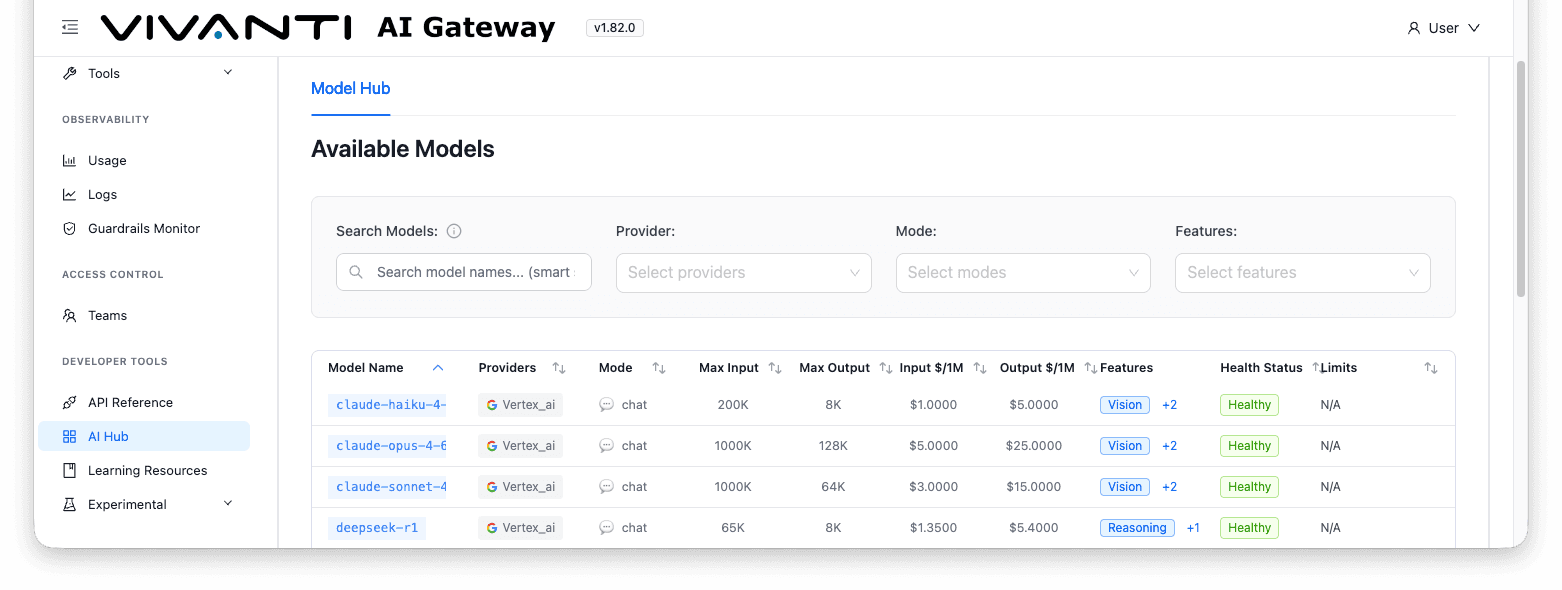
Controlling Spend
An AI gateway turns opaque vendor bills into granular, attributable costs.
With LiteLLM, you can allocate budgets at the project or team level. Every request is tagged — you know exactly how many tokens marketing used on Claude versus how many engineering burned through on GPT-4. You can set hard spend limits per API key or per project, cutting off usage before it spirals.
Pair this with a reporting dashboard — such as Vivanti's PromptShield (disclosure: our product) — and leadership gets a consolidated view of spend across all providers without logging into five separate consoles.
Security and Data Governance
This is where centralisation pays for itself.
A gateway gives you a single enforcement point for data policies. Concretely, that means:
- PII masking. Sensitive fields (names, emails, account numbers) can be detected and redacted before requests leave your network. LiteLLM supports pre-request hooks where you can plug in your own masking logic or integrate tools like Presidio.
- Content filtering. Responses can be scanned for harmful or off-policy content before they reach the end user, using moderation endpoints or custom callback functions.
- Audit logging. Every request and response passes through a single point, making it straightforward to log, review, and demonstrate compliance.
- Data residency. Because the gateway runs in your own infrastructure, data never has to leave your cloud boundary unless you choose a provider that requires it.
This architecture also reduces vendor lock-in. Because the gateway abstracts the provider behind a standard API, switching from one model to another is a configuration change, not a code change.
Implementation
Moving from pilots to a governed capability takes deliberate effort. A phased approach works well:
- Assess. Inventory current AI usage across the organisation. Identify which teams are using which providers, what data is being sent, and where the governance gaps are. Define policies for acceptable use, data handling, and budget limits.
- Deploy. Stand up the LiteLLM proxy in your cloud environment. Configure model routing, authentication (virtual keys, SSO integration), and spend limits. Connect logging to your observability stack.
- Roll out. Migrate teams onto the gateway incrementally. Start with the highest-risk or highest-spend teams. Provide self-service access with guardrails so teams can move fast without bypassing policy.
The gateway runs as a containerised service — deployable on any cloud or on-premise infrastructure. No vendor-hosted SaaS dependency is required.
The Foundation for What Comes Next
Distributing API keys is not a strategy. A governed gateway gives you the control surface to standardise access, attribute costs, enforce data policies, and swap providers without rework. It turns AI from a collection of disconnected experiments into infrastructure you can build on.
Written byNizar HabbalDirector